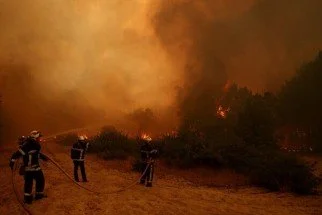
When Wildfire Smoke threatens our air, Leaf Blowers make Pollution worse.
· Climate change is fueling larger, more intense Canadian wildfires. Rising temperatures and prolonged droughts mean longer fire seasons and unpredictable air quality spikes in cities like Toronto.
The greatest threat is fine particulate matter (PM2.5) in smoke. These microscopic particles bypass our body's natural defenses, penetrating deep into our lungs and bloodstream. Exposure can aggravate respiratory conditions and increase the risk of cardiovascular and respiratory illness.
A major culprit is the two-stroke gas-powered leaf blower. These tools emit massive amounts of greenhouse gases, nitrogen oxides, and fine particulates. When wildfire smoke already threatens the air we breathe, cutting out these unnecessary local emissions can help limit additional pollution .
“Air pollution is already associated with 17,000 premature deaths every year and more than $140 billion of economic damage in Canada annually and that burden could increase if air quality worsens.” Rebecca Saari, Canada Research Chair in Global Change, Atmosphere and Health, Associate Professor, University of Waterloo.
Every avoidable source of pollution matters when the air we breathe is under threat.
Toronto City Council passed a landmark no-leaf-blower motion inspired by the advocacy of Gasbusters.
” When wildfire smoke pushes Toronto’s Air Quality Health Index into unhealthy, high (7-10) or very unhealthy, very high risk (10+) Council directs city operations, businesses, and residents to refrain—wherever practical and feasible—from using 2-stroke gas-powered leaf blowers.”
Air Quality Alert Programs
Public Index Scales
To make air quality easier for the public to understand, environmental agencies convert raw PM2.5 data into a simplified health scale. As the pollution gets heavier the scale number increases .Severe wildfire smoke events can cause concentrations to spike to thousands of \(\mu g/m^3\)
But the health scale index has structural limits and cannot mathematically go higher than 10+ very high risk, even if wildfire smoke thickens to hazardous conditions.
The Air Quality Health Index (AQHI - Canada):
This scale ranges from 1 to 10. The scale caps out visually at a maximum classification of 10+ "Very High Risk")
The Air Quality Index (AQI - United States):
The standard U.S. Environmental Protection Agency (EPA) index runs from 0 to 500. A value of 500 represents the structural cap of the scale. Any reading beyond 500 is simply classified as "Beyond the AQI" , meaning hazardous pollution has outpaced the design of the scale.
(Ontario Ministry of the Environment, Conservation and Parks, and Environment and Climate Change Canada.)
.The Air Quality Alert Program is designed to help people take protective actions during periods of elevated air pollution,
Yellow Warning –
Issued when Air Quality Health Index (AQHI) is forecast to reach the high-risk category (AQHI 7–9).
Orange Warning –
Issued when AQHI is forecast to reach, or has reached, the very high-risk category (AQHI 10+).
Letter from Health Canada.
From:donotreply-nepasrepondre@gc.canada.ca
Sent: 2026-05-30 7:09 PM
To: INFO (PHAC/ASPC) <info@phac-aspc.gc.ca>
Subject: Contact Form - pollution from 2 stroke leaf blowers
9:09 AM , June 24, 2026
“Dear Gasbusters,
Thank you for your enquiry from May 30, 2026.
The Air Quality Health Index (AQHI) is a health protection communication tool designed to help you make informed decisions to limit short-term exposure to air pollution and adjust your outdoor activities. It is a collaborative initiative between Environmentand Climate Change Canada, Health Canada, and Provincial Ministries.
The federal government calculates, forecasts, and reports on the AQHI while providing nationwide health messaging. Concurrently, in Ontario, the Ministry of the Environment, Conservation and Parks (MECP) reports on local AQHI values using a comprehensive network of ambient air monitoring stations.
Air quality can have a significant impact on public health and some populations facing a higher risk of health issues from air pollution. These high-risk groups include seniors, infants and young children, pregnant individuals, and those with pre-existing conditions like cardiovascular or lung disease, asthma, and diabetes as well as those working and/or performing strenuous activities outdoors.
During periods of poor air quality, such as wildfire smoke events, where health risks are elevated, MECP works closely with Public Health Ontario to distribute specific health messaging and advisories to protect residents. Under its municipal mandate, the City of Toronto likely utilizes its policymaking and guidance capabilities to actively protect these at-risk groups.
Gas leaf blowers can produce disproportionately large amounts of air pollutants. Operating this equipment, particularly two-stroke engines, elevates people’s exposure to toxic air pollution and exacerbates conditions, especially during poor air quality events. The aim of restricting gas leaf blowers during poor air quality events would likely be to help avoid further air quality degradation and protect public health.
I hope you find this information helpful.”
Sincerely,
Air team - Water and Air Quality Bureau -
Health Canada